

News | Industrial Combustion Equipment
All the latest News on our company


New oil refineries in Africa
Posted on: 20 / 08 / 2026 | 0 Comentarios | Tags: Burners for heaters in oil and gas, E&M Combustión, New oil refineries, Quemadores para Heaters de Oil and Gas
New oil refineries in Africa: Nigeria (Dangote), Ghana, Niger… West Africa is increasing its refining capacity. Following up on our previous article, “New refinery projects worldwide: investments, capacity, and trends”, we present the projects in Africa that have either been launched or are currently under study.
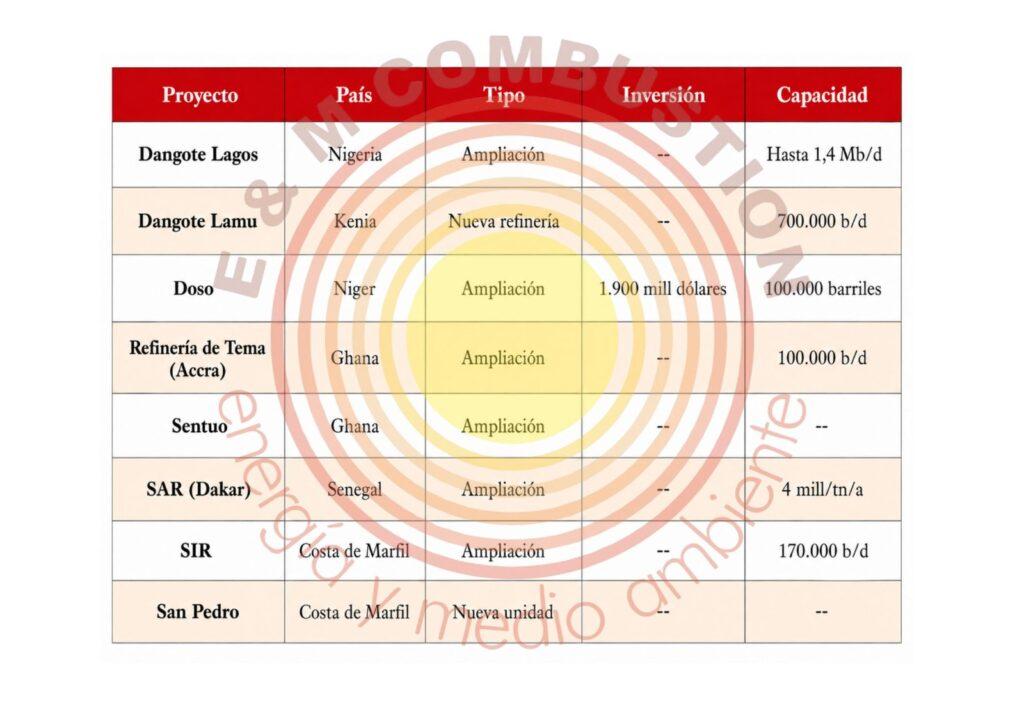
Despite having produced crude oil for some fifteen years and remaining vulnerable to fuel shortages, Niger seeks to boost its refining capacity through a project valued at €1.6 billion. This initiative is part of a broader trend in West Africa, where several crude-producing nations are attempting to reduce their historic reliance on imports.
Against this backdrop, Niger has joined the race to expand refining capacity in West Africa. La Tribune reports that on August 15, the country signed a $1.9 billion (approximately €1.64 billion) agreement with the Canadian company Zimar to build a refinery in Dosso with a capacity of 100,000 barrels per day. Much like the launch of the Dangote refinery in Nigeria and new investments in Ghana, Senegal, and Côte d’Ivoire, Niamey shares a common goal: to process more crude oil within the sub-region in order to cut the still-massive dependence on imported fuel.
Although West Africa is home to major oil producers—including Nigeria, a global powerhouse in the sector—operational refineries are scarce in the region. While five countries possess processing facilities (Nigeria, Ghana, Côte d’Ivoire, Senegal, and Niger), their combined nameplate capacity stood at just under 620,000 barrels per day prior to the inauguration of the Dangote refinery, according to S&P Global data. The facility owned by the Nigerian billionaire, capable of processing 650,000 barrels of crude oil daily, has significantly boosted regional capacity; however, a major problem persists: most West African refineries operate below their nameplate capacity. Consequently, 69% of the 2.05 million tonnes of gasoline marketed monthly in West Africa in 2025 came from imports, compared to 31% supplied by refineries within the region.
New refineries in the region: Dangote is no longer alone
Dangote has undoubtedly marked a turning point in West Africa’s energy sector. The Nigerian refinery is already supplying several markets, and its steadily increasing activity has reduced the flow of refined products from abroad. In May 2026, imports of refined petroleum products into West Africa fell by 23% compared to the previous month, according to S&P Global. However, the trend extends beyond that country.
Regarding new oil refineries in Africa, Ghana is making progress on two fronts. The state has launched a reshaping and expansion program aimed at restoring and increasing the processing capacity of the Tema Oil Refinery, while also working to boost the capacity of Sentuo—a refinery located in the Tema industrial zone near Accra—from 40,000 to 100,000 barrels per day. The facility has begun receiving crude oil from Ghana’s Jubilee field, offering the country the opportunity to process a larger share of its own output rather than exporting crude only to import fuel later.
Senegal is starting from a more modest base. The Société Africaine de Raffinage (SAR) operates the country’s only refinery, located near Dakar; it is an aging facility that processes approximately 1.5 million tons of crude oil annually. The SAR 2.0 program aims to achieve a new refining capacity of 4 million tons per year. Meanwhile, Côte d’Ivoire plans to build a second unit with a capacity of 170,000 barrels per day in San Pedro, alongside the modernization of the Société Ivoirienne de Raffinage (SIR) facilities.
Energy efficiency and combustion technologies in the industry
Beyond increased production, the real innovation lies in the technological transformation of refineries. The new generation of refining projects cannot be analyzed solely in terms of capacity. Integration with petrochemicals, energy efficiency, emissions reduction, and the ability to process various types of crude oil are becoming increasingly important within the sector.
In this context, combustion systems—such as those developed by E&M Combustion—play a fundamental role in numerous refinery process units. Industrial furnaces and heaters require solutions capable of operating stably under varying operating conditions and with different fuels, all while maintaining high levels of efficiency and emissions control.
Air-fuel ratio regulation, flame control, safety system management, and combustion optimization are essential for ensuring efficient and safe operation. Furthermore, in complex industrial facilities, the commissioning, calibration, and maintenance of combustion systems are crucial for preserving equipment performance throughout its service life.
You might also be interested in the article “New refinery projects worldwide: investments, capacity, and trends”
or “Oil and gas value chain: Focus on refining”