
News | Industrial Combustion Equipment
All the latest News on our company

300 million in aid for producing renewable technology equipment and components
Posted on: 30 / 06 / 2025 | 0 Comentarios | Tags: E&M Combustión, Equipos de tecnologías renovables, Equipos para hidrógeno, Hydrogen equipment, Renewable technology equipment
MITECO is awarding nearly 300 million euros in aid for producing renewable technology equipment and components in Spain, as part of the renewable energy value chain reinforcement program (RENOVAL).
The Ministry for Ecological Transition and the Demographic Challenge (MITECO) grant covers 33 projects, aiming to boost the manufacturing of electrolyzers for green hydrogen production, solar panels, wind turbines, heat pumps, and batteries, as well as essential components for these technologies.
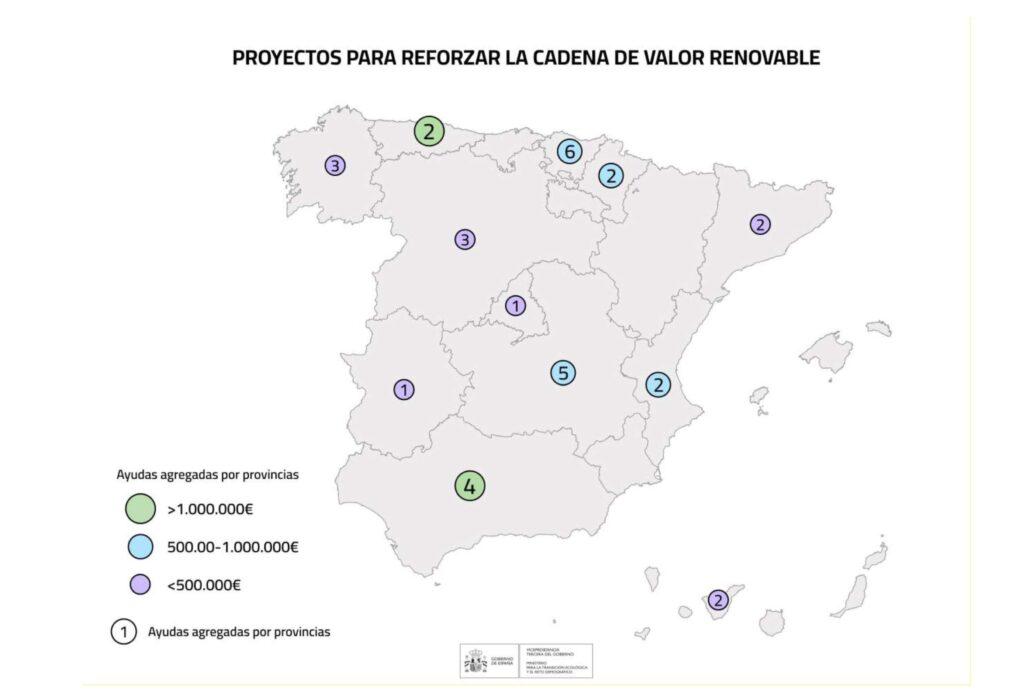
In this way, the RENOVAL program will contribute to strengthening the value chain and industrial development in a large part of the country, as the projects will be located in 12 autonomous communities. It also contributes to the development of essential systems to guarantee energy security and autonomy, increase the country’s competitiveness, and decarbonize industry, in line with the policies defined by the EU.
This line of incentives, managed by the Institute for Energy Diversification and Saving (IDAE), will boost Spain’s capacity to produce solar panels, wind turbines, heat pumps, batteries, electrolyzers for the production of green hydrogen, as well as essential components of these technologies. The projects, selected through competitive bidding, will be located in 12 autonomous communities. The Basque Country, with six, and Castilla-La Mancha, with five, are the ones hosting the largest number of proposals. The rest are distributed between Andalusia (4), Galicia (3), Castilla y León (3), the Canary Islands, Catalonia, Navarre, the Valencian Community and Asturias, with two each, and Extremadura and Madrid, with one respectively.
Equipment for hydrogen, wind, photovoltaic and storage
Thirty percent of the applications correspond to the manufacturing and assembly of electrolyzers and other components for the production of green hydrogen (10 projects). Meanwhile, 33% (11 projects) are allocated to the development of wind energy structures and equipment. Another seven (21%) are solar photovoltaic projects, four correspond to battery equipment and components for electrical storage (12%), and one to the manufacture of heat pumps (3%). All of them adhere to the guiding principle of causing no significant harm to the environment (DNSH).
Among the selected projects, the proposal by SUNWAFE S.L. stands out due to its nature and the amount of aid allocated. This project, located in Asturias, will receive almost 200 million euros for the manufacture of silicon ingots and wafers, essential components in the production of photovoltaic panels.
Basque renewable technology projects
With the final approval of the aid program for producing renewable technology equipment, the Basque Country’s leadership is highlighted, with six projects approved.
- Arizaga, Bastarrica y Compañía (Eibar)
- Haizea Bilbao (Zierbena)
- Haizea WEC Fundición (Agurain/ Salvatierra) y WEC Mecanizado (Deba)
- Hydrogen ONSITE (Loiu)
- FIHI Forging Industry (Zestoa)
- BIHAR Batteries (Oyartzun)
This IDAE incentive program is supported by NextGenEU funds from the Recovery, Transformation, and Resilience Plan (PRTR) and will contribute to strengthening the entire innovative and knowledge-based value chain surrounding renewable energy in Spain, both in mature technologies, such as solar photovoltaic and wind power, and in emerging technologies, with renewable hydrogen at the forefront. It will also allow for the development of new technological and industrial capabilities to guarantee energy security, increase our competitiveness, and decarbonize industry.
Framed in the PERTE ERHA
This program is funded by Spain’s Recovery Plan, as part of the REPowerEU component, which was introduced in October 2023. This additional disbursement strengthens the PERTE ERHA (Renewable Energy, Renewable Hydrogen, and Storage) program, which includes this line of aid. The goal is for these reinforcement actions to enable not only the deployment of the energy transition, but also for the technologies and/or solutions to be designed and manufactured in Spain.